


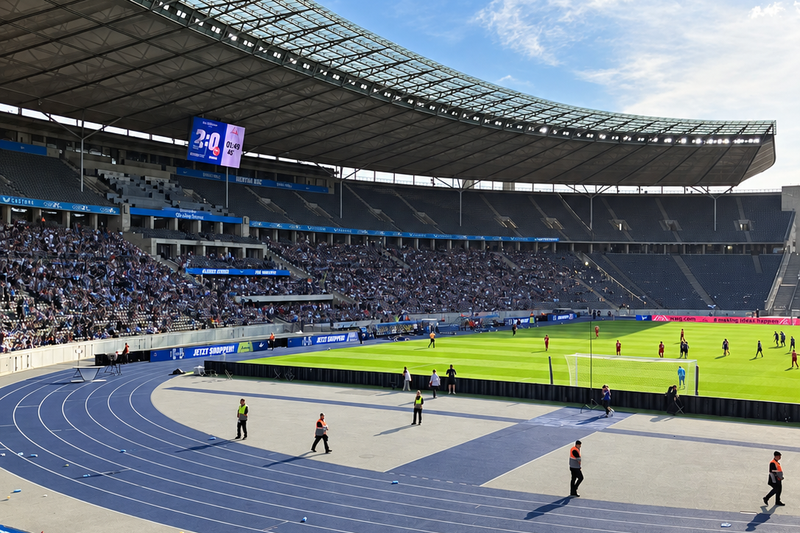
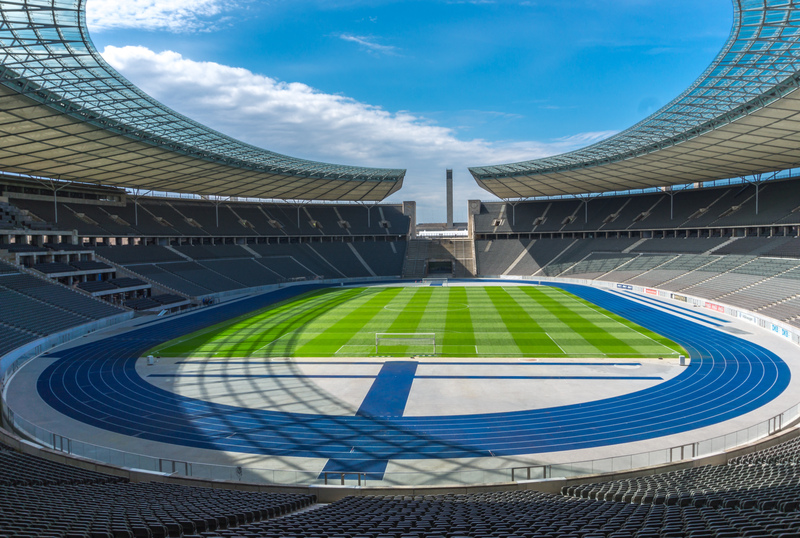
A borehole heat exchanger field for Berlin’s Olympic Stadium
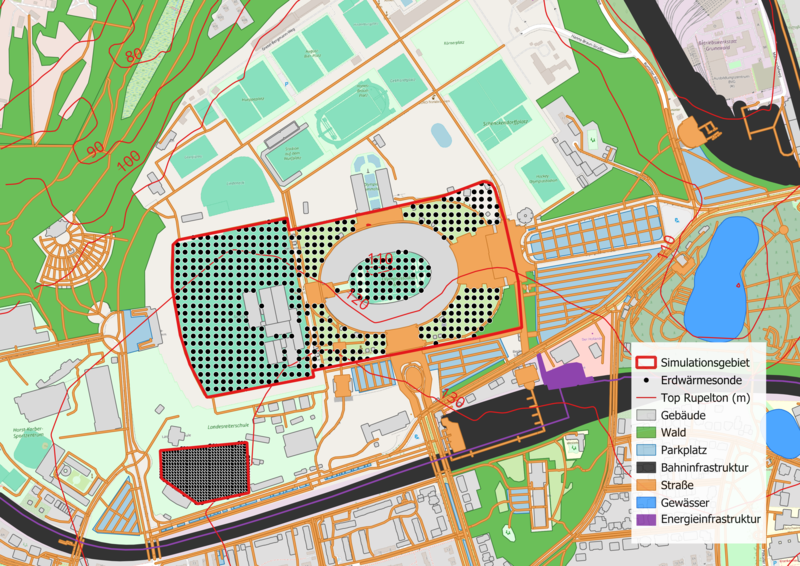
For the existing Olympic Stadium and the adjacent Maifeld, the research team investigated options including borehole heat exchangers. According to the modelling, more than 500 borehole heat exchangers, each approximately 110 metres deep, could be installed in this area. The heating energy available from such a system would, in theory, be sufficient to meet the Olympic Stadium’s entire heating demand.
Berlin’s Olympic Park currently has an annual heating demand of around 23 gigawatt-hours and an electricity demand of seven gigawatt-hours. The Olympic Stadium alone accounts for approximately five gigawatt-hours of heat and electricity consumption per year. According to the technical article, energy consumption across the Olympic Park currently causes greenhouse gas emissions of around 6,740 tonnes per year.
“As decisions are now being made about new construction and the long-term development of Berlin’s Olympic Park, this is a good opportunity to consider its future heat supply from the outset. Our modelling, based on geoscientific data in the Geothermal Information System GeotIS and our methodology for assessing geothermal potential within the WärmeGut research project, shows that shallow geothermal energy offers considerable potential here, both for the existing Olympic Stadium and for a possible new stadium on the equestrian stadium site,” says Prof. Dr Inga Sigrun Moeck, Head of Research Department at the LIAG Institute for Applied Geophysics and Professor of Applied Geothermics and Geohydraulics at the University of Göttingen.
A new stadium on the former equestrian stadium site
The investigations extend beyond the existing Olympic Stadium. The research team also included a possible new stadium on the site of the former equestrian stadium in its modelling. According to the calculations, a field comprising more than 500 borehole heat exchangers could also be installed there. Favourable geological conditions at the former equestrian stadium site would allow boreholes to extend approximately 10 to 20 metres deeper than beneath the Olympic Stadium. For large developments such as a new stadium, a borehole heat exchanger field can also be designed as a large-scale thermal energy store, rather than solely as a heat source, as demand for seasonal heat storage for district heating is growing and funding is available to support it.
“A large borehole heat exchanger field could serve as a seasonal thermal energy store. Surplus heat, for example from cooling buildings, could be stored underground in summer and recovered later,” explains Moeck. The researchers therefore recommend incorporating geothermal systems into an integrated heating and cooling strategy for the further development of the Olympic Park.
The researchers also investigated horizontal collector wells for thermal energy use. Under suitable conditions, these could provide thermal output in the megawatt range. Whether they could ultimately meet the heating demand of the entire Olympic Park would, however, require further investigation. Another illustrative calculation presented in the technical article shows that, depending on the system design, a sports pitch covering approximately 7,140 square metres could use ground heat collectors to supply heat to 50 to 80 single-family homes or several public buildings, such as schools, nurseries or sports halls. According to the researchers, borehole heat exchangers or horizontal collector wells can access even greater quantities of thermal energy, enabling heating and cooling to be supplied to several hundred to several thousand households.
Research to support practical planning for geothermal energy use at sports facilities
The calculations draw on research conducted within the WärmeGut collaborative project. The project harmonises geological data from Germany’s federal states and makes them available through the freely accessible Geothermal Information System GeotIS. To investigate the Olympic Park, the LIAG research team used various digital analytical methods and additionally developed a GIS-based approach that automatically identifies potential areas for borehole heat exchanger fields, taking account of existing buildings, roads and other constraints. This makes it possible to estimate geothermal potential at specific sites at an early stage of planning. The Olympic Park illustrates how these data and methods can be applied to large sports grounds.
Sports grounds are particularly promising for shallow geothermal energy use because they offer large, largely undeveloped areas. Renovating a pitch would also involve substantial earthworks in any case, allowing geothermal systems to be integrated with comparatively little additional effort. Depending on the geological conditions at the site, suitable options include ground heat collectors, borehole heat exchangers and horizontal collector wells. With borehole heat exchangers, the surface remains fully usable afterwards.
The researchers therefore conclude that sports facilities could play a greater role in the transition to low-carbon heating in urban areas, both through energy upgrades to existing facilities and through new construction.
Background information
The findings were published in September 2026 in Geothermische Energie, issue 115, under the title “Energiewende im Stadion mit Geothermie am Beispiel des Berliner Olympiaparks” (“The energy transition in stadiums through geothermal energy: the example of Berlin’s Olympic Park”). The article was written by Inga Sigrun Moeck and Jens-Olaf Delfs from LIAG, together with Fabian Neth from Biberach University of Applied Sciences and Nico Oesemann from H. Anger’s Söhne Bohr- und Brunnenbaugesellschaft mbH.
Funding: The WärmeGut collaborative project is funded by the Federal Ministry for Economic Affairs and Energy under grant number 03EE4046.
Further information about the WärmeGut research project and GeotIS:
Scientific contact
Prof. Dr Inga Moeck
LIAG Institute for Applied Geophysics
Stilleweg 2, 30655 Hannover, Germany
Tel.: +49 511 643 3468
Email: Inga.Moeck(at)liag-institut.de