


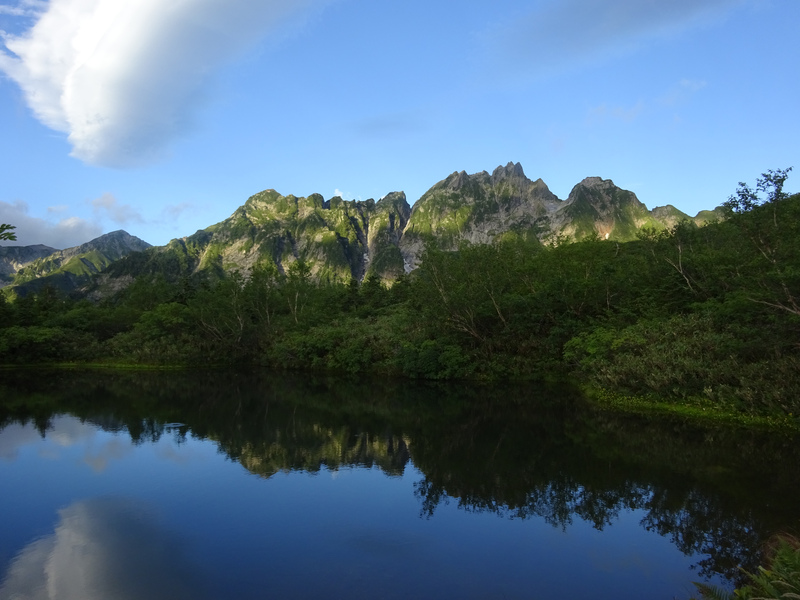
A mountain range without an obvious uplift mechanism
Mountain ranges commonly form where the Earth’s crust is compressed or where blocks of rock move along major faults. The Himalayas and the European Alps are well-known examples.
In the Northern Japanese Alps, also known as the Hida Mountains, however, such mechanisms were difficult to explain the pronounced uplift. Unlike the Central and Southern Japanese Alps, no major faults have been identified that could account for the substrantial uplift.
At the same time, the Northern Japanese Alps contain several volcanoes, raising the question of whether volcanic activity may have contributed to the mountain building.
The world’s youngest granite provides a crucial clue
An important clue comes from the granite exposed in the Kurobe region. The area contains the world’s youngest known granite at the Earth’s surface.
Granite forms when magma slowly cools and solidifies several kilometres below ground. The presence of such young granite at the surface therefore points to exceptionally rapid uplift and erosion.
The research team collected rock samples at elevations of approximately 700 to 2,400 metres and determined both their ages and the depths at which the granites had formed. Geothermobarometric analyses were used to reconstruct the pressure and temperature conditions during rock formation, while zircon U–Pb dating provided information on their age.
Six to nine kilometres of rock removed in 800,000 years
The results show that the granites now exposed at the surface formed around 800,000 years ago at depths of six to nine kilometres. Since then, all of the overlying rock has been removed by erosion.
The resulting erosion rates reached close to one centimetre per year. This places the region among those with the highest known uplift and erosion rates worldwide, comparable with particularly dynamic regions in the Himalayas, the European Alps, Taiwan and New Zealand.
Volcanic heat weakens the Earth’s crust
To investigate what could have caused such rapid development, the researchers modelled crustal deformation in central Japan while incorporating the spatial distribution of subsurface temperatures.
The simulations showed that particularly rapid local uplift develops in areas where volcanic heat weakens the crust. When the region is subjected to horizontal compression, deformation preferentially becomes concentrated in these hotter and mechanically weaker areas.
A new perspective on mountain building
The study therefore broadens the conventional understanding of mountain building. Very rapid uplift has traditionally been associated mainly with continental collision zones and major fault systems. The new results indicate that volcanic heat and magmatic activity can also play an important role in subduction zones. The findings may therefore be relevant far beyond the Japanese Alps, as similar processes could occur in other volcanically active subduction zones around the world. A more detailed understanding of the relationship between volcanic activity and crustal deformation could also help researchers better understand how mountain ranges grow and how earthquakes are distributed and generated in subduction zones.
LIAG involved in study design and fieldwork
Sumiko Tsukamoto at LIAG contributed to the conception and planning of the study as well as to fieldwork and sample collection. The international research team, led by researchers from the Japan Atomic Energy Agency, Kyoto University and the University of Lausanne brought together expertise in geology, geochronology, thermochronology and numerical modelling.
This text is a short version and adjusted from the original press release in Japanese language: LINK
Publication
SUEOKA, S.; KAWAKAMI, T.; SUZUKI, K.; KAGAMI, S.; YOKOYAMA, T.; SHIBAZAKI, B.; OSADA, M.; YAMAZAKI, A.; HIGASHINO, F.; KING, G. E.; TSUKAMOTO, S.; HERMAN, F.; TAGAMI, T. (2026): Extreme exhumation along a volcanic arc exposed the world’s youngest pluton in the Japanese Alps. - Earth and Planetary Science Letters, 692: 120218. https://doi.org/10.1016/j.epsl.2026.120218.
Link to original press release in Japanese.
Background
Why is the granite important?
Granite normally forms several kilometres below the Earth’s surface. Finding very young granite exposed at the surface therefore indicates that the overlying rock must have been removed through uplift and erosion within a geologically short period of time.
What is a subduction zone?
A subduction zone is an area where an oceanic plate sinks beneath another tectonic plate. These regions are commonly associated with earthquakes, magma generation and volcanic activity. Japan is located within such a highly active tectonic setting.