


MoreSpin II
Soil moisture is a key parameter for a wide range of ecological processes, and accurate, non-destructive measurements of this parameter are becoming increasingly important, particularly in light of climate change. To this end, the MoreSpin project extended the established surface nuclear magnetic resonance (surface NMR) method, which is typically used to determine the water content of the saturated zone, with prepolarization to achieve higher signal amplitudes from the near-surface.
Prepolarization coil for enhanced signal amplitudes
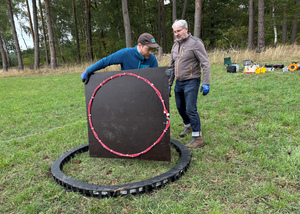
Surface NMR typically uses surface coils with diameters ranging from 10 to 100 meters. To apply this method to soils, smaller layouts are required; however, due to the resulting small sensitive volume, these would produce an NMR signal that is too weak to measure. In the MoreSpin project, the use of a prepolarization coil to amplify the signal was therefore evaluated. In the recently completed second phase of the project, we focused on the following points:
Developing the theoretical foundations
The use of prepolarization alters the orientation of the macroscopic magnetization in the subsurface at the start of the NMR experiment. This influences the behavior of the magnetization during the NMR pulse and the recorded signal. Furthermore, measuring soil moisture requires short, high-intensity NMR pulses through which the Bloch–Siegert effect comes into play. The precise modeling of these two effects is essential for the inversion of the soil moisture profile and was implemented in the MRSmatlab software.
Layout Optimization
A coil layout that ensures stable noise suppression regardless of the orientation relative to potential sources of electromagnetic noise was developed. In addition, a sensitivity study was conducted to optimize both this layout and the classic layout for soil moisture measurements at various investigation depths.
Compact magnetic field sensors
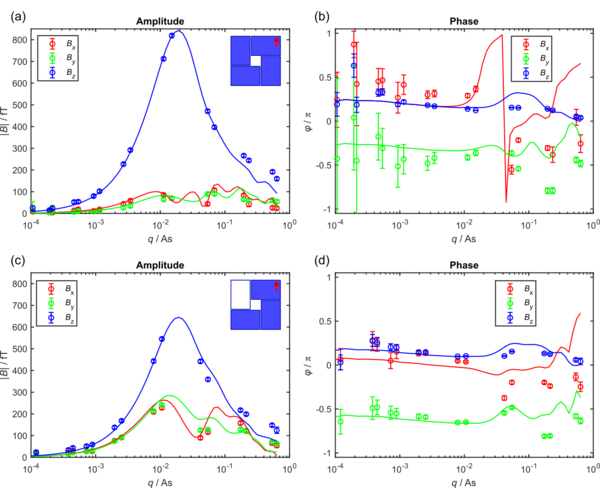
In a surface NMR experiment, a magnetic field oscillating at the Larmor frequency is generated in the subsurface. Typically, the voltage induced by this field in a surface coil is measured. In the Morespin project, magnetic field sensors were used to measure the oscillating magnetic field directly. These sensors are more compact than coils and allow for the recording of the three spatial components of the magnetic field. This results in additional directional sensitivity, while conventional coils are primarily depth sensitive. In the future, this could enable three-dimensional analysis of NMR data for heterogeneous subsurfaces.
Application to soils
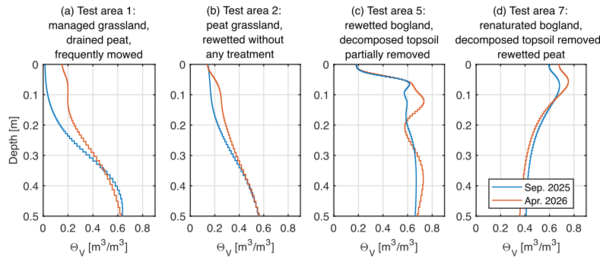
Several field campaigns were conducted as part of the project to demonstrate the applicability of the developed method. The focus here was on peat soils. Following a measurement campaign in the Gnarrenburg Moor, soil samples were collected from the measurement locations. This enabled a comparison of laboratory NMR data with the surface NMR data measured in the field. In addition, measurement campaigns were conducted on test plots for the rewetting of bogs, which we plan to repeat in regular intervals.
Superconducting prepolarization coil
As part of the project, the collaboration partner Leibniz-IPHT developed a superconducting prepolarization coil cooled with liquid nitrogen. This will enable higher prepolarization fields and, consequently, larger signal amplitudes for the application of the method. Initial measurements using this superconducting coil were conducted on water containers at the LIAG test site Schillerslage, in the Hanover region.
Outlook
In the future, the surface NMR method using a prepolarization coil will be made even more portable and improved for practical on-site applications. In addition we plan to apply the new developments to other geophysical and environmental topics, such as the hydraulic conductivity of soils and peatland rewetting effords.
The second phase of the project has been completed
Publications
- Hiller, T., Costabel, S., Dlugosch, R., Splith, T. & Müller-Petke, M. (2023): Advanced surface coil layout with intrinsic noise cancellation properties for surface-NMR applications. - Magnetic Resonance Letters, 3(2): 140-149. https://doi.org/10.1016/j.mrl.2023.03.008
- Splith, T., Hiller, T., & Müller-Petke, M. (2024): Bloch–Siegert Effect for Surface Nuclear Magnetic Resonance Sounding Experiments in the Unsaturated Zone. - Applied Magnetic Resonance, 55(4): 357-373. https://doi.org/10.1007/s00723-023-01582-3
- Splith, T. & Müller-Petke, M. (2024): Compact SNMR sensors: a sensitivity study. - RAS Techniques and Instruments, 3(1): 815-827. https://doi.org/10.1093/rasti/rzae056
- Splith, T., Hiller, T., Costabel, S. & Müller-Petke, M. (2025): Surface-NMR for soil moisture investigation: Principles and methods of prepolarisation-enhanced SNMR. In: NMR in Plants and Soils: New Developments in Time-domain NMR and Imaging. - Royal Society of Chemistry, 37: 187 - 210. https://doi.org/10.1039/9781837673452
- Costabel, S., Splith, T., Hiller, T., & Müller-Petke, M. (2025): Mobile NMR Relaxometry for Characterising Peat Soil Decomposition. In: NMR in Plants and Soils: New Developments in Time-domain NMR and Imaging. - Royal Society of Chemistry. https://doi.org/10.1039/9781837673452
- Splith, T., Hiller, T., Costabel, S. & Müller-Petke, M.(2025): SNMR with short pulses: Optimizing the kernel calculation by considering the influence of pulse shape and phase. - Magnetic Resonance Letters, 6(1): 200223. https://doi.org/10.1016/j.mrl.2025.200223
- Splith, T., Chwala, A., Hiller, T., Davis, A.C., Dlugosch, R., Stolz, R. & Müller-Petke, M. (2025): PPSNMR measurements using SQUIDs as compact three-component B-field sensors for spatial imaging. - Journal of Magnetic Resonance, 376: 107888. https://doi.org/10.1016/j.jmr.2025.107888
- Beisembina, G., Splith, T., Costabel, S., Hiller, T. & Müller-Petke, M. (2026): Comparison of prepolarized surface NMR and conventional laboratory NMR in a peatland area. - Journal of Applied Geophysics, 257: 106536. https://doi.org/10.1016/j.jappgeo.2026.106536
Team
Project management
Prof. Dr. Mike Müller-Petke
+49 511 643-3253
Project scientist
Dr. Tobias Splith
+49 511 643-2922
Partners

Funding

Grant no. MU 3318/8-1
Duration
01.01.2022-31.03.2026
Links
Geoelectrics and Electromagnetics