


LIAG research supports UNESCO World Heritage nomination of the Schöningen archaeological site
By reconstructing depositional environments and environmental change, geophysical investigations and sediment analyses provide important scientific evidence supporting the World Heritage nomination of one of the world's most significant archaeological sites. The Schöningen archaeological site is one of the world's most extraordinary archaeological locations. Around 30 years ago, the Schöningen Spears were discovered there—the oldest completely preserved hunting weapons known to humanity. They provide unique insights into human behaviour and ecosystems that have been considered to date to approximately 300,000 years ago.
Geophysics complements archaeological research
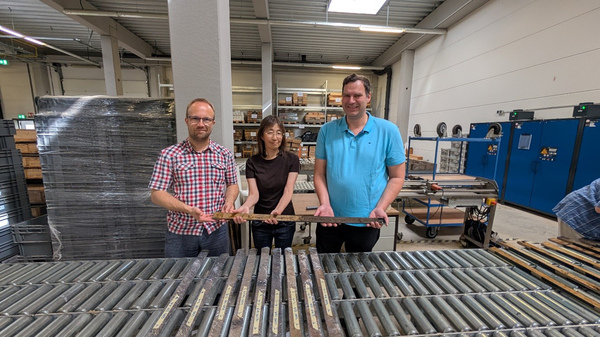
Today, the LIAG Institute for Applied Geophysics contributes to the scientific investigations aimed at further unravelling the geological and sedimentological history of the site. The institute brings to the project its extensive expertise, developed through many years of research on the environments and living conditions of Neanderthals and early humans, including projects such as Lichtenberg or CCEHN in Lower Saxony. By combining this experience with state-of-the-art geophysical and sedimentological methods, LIAG provides unique insights into the formation and preservation of the Schöningen site.
Working together with the Lower Saxony State Office for Cultural Heritage (NLD) and universities in Hanover, Lüneburg, Braunschweig, Mainz, and Tübingen, LIAG scientists investigate the formation history of the sediments in which these world-famous archaeological finds have been exceptionally well preserved for hundreds of thousands of years.
Reconstructing depositional environments and environmental change
As part of the preparations for the UNESCO World Heritage nomination of the Schöningen archaeological site, Dr Dirk Leder from NLD coordinates the geoscientific investigations of the sediments. LIAG contributes its expertise in two key areas: Prof. Dr Sumiko Tsukamoto applies luminescence dating to sediment cores to establish the age of the sediment sequences, while Dr Christian Zeeden investigates the magnetic properties of the sediments. These analyses provide valuable information on the age of the archaeological layers as well as its depositional environments and environmental changes . Together, the two approaches enable a much more detailed reconstruction of the landscape and its environmental evolution in which early hominins lived and hunted around a lake during a warm interglacial. The analyses are funded by the Lower Saxony Ministry of Science and Culture (MWK).
In this way, geophysical and geoscientific methods complement archaeological research by providing crucial insights into the formation history of the site and strengthening the scientific basis of the UNESCO World Heritage nomination.
Schöningen on the path to UNESCO World Heritage status
At the end of 2023, the Standing Conference of the Ministers of Education and Cultural Affairs included the Schöningen archaeological site on Germany's Tentative List for UNESCO World Heritage status. Germany plans to submit the nomination proposal to the World Heritage Committee in 2026. Following a preliminary assessment and revision of the nomination dossier an inscription on the World Heritage List is currently expected in 2031.