The Dust of Time: Deciphering Alternating Dust Patterns through Records in Southern Tunisia
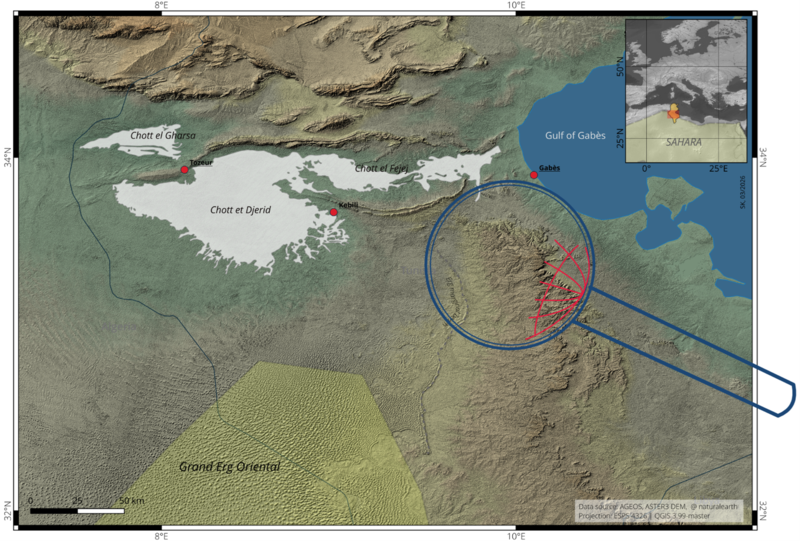
Four researchers from Tunisia, Switzerland, and Germany launched a new field campaign studying windblown desert-margin deposits around Matmata, southern Tunisia. The project targets sediment deposits that recorded an important global climate shift towards colder temperatures approximately 81,000 to 71,000 years ago. Measuring how these changes occurred using local sediment samples is very important for understanding how quickly and by how much global systems change regionally. This research is also part of a bigger effort to study and model how dust moves in North Africa and the Mediterranean, which matters for both ancient and modern societies in Europe, for example, because Saharan dust can make the air, also in Europe, very dusty.
Sediment analysis and luminescence dating for chronology
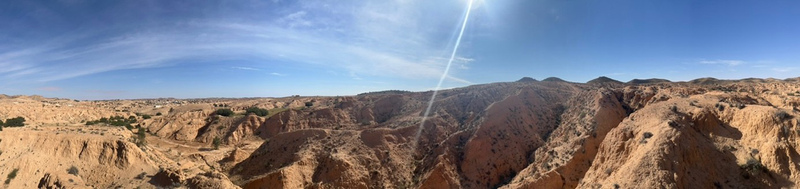
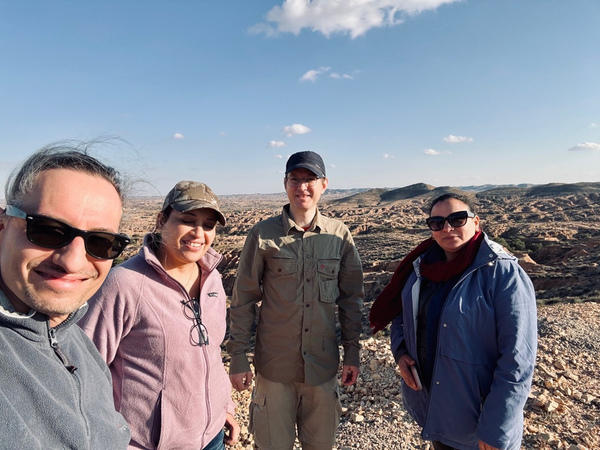
The work is part of a one-year pilot study between the INRAP in Tunisia, the Université de Lausanne in Switzerland, and the LIAG in Hannover. During the one-week field campaign end March 2026, the group consisting of Dr Hajer Merji, Dr Nadia Ben Moktar (both Tunisia), Dr Christoph Schmidt (Switzerland), and Dr Sebastian Kreutzer (Germany) collected samples for geochemical, provenance and luminescence dating analysis from four pre-selected sediment profiles with known stratigraphic composition. The focus was on locations marking the Marine Isotope Stages (MIS) 5a-4 transitions (82,000–71,000 years ago), a critical paleoclimatic shift from interglacial to glacial conditions that may exhibit regional patterns different from those in Europe.
What’s next?
After the successful field campaign, the team will focus on laboratory analysis over the next few months. The group in Tunisia will be responsible for sediment analysis, while Switzerland and Germany will focus on the chronology and provenance of the dust, allowing the reconstruction of shifts in major atmospheric circulation patterns during the period of interest. The team will rejoin in summer 2026 to discuss the first results and strategies and organise a workshop in Tunisia by the end of this year, for which additional experts will be invited.
Background and financial support
The windblown sediment deposits in Matmata, Tunisia, known as “desert loess,” represent a unique sediment archive. While such deposits in Europe are usually linked to glacial phases, for instance, as found in loess deposits near Heidelberg and Dresden, the dust system in Tunisia follows a different dynamic. In Tunisia, the dust most likely originates from deflation zones in the Grand Erg Oriental, the Chotts (large endorheic dry lakes), or exposed coastal plains. The dominant source depends on the superregional environmental conditions and is mainly governed by the availability of water. For instance, when the Chotts are water-filled, they likely do not contribute to sediment accumulation.
The project is part of a Swiss initiative to develop scientific collaborations with the Middle East and North Africa (MENA), commissioned by the HES-SO (University of Applied Sciences and Arts Western Switzerland).
The funding for the pilot study was acquired by Dr Hajer Merji (INRAP - Institut National de Recherche et d’Analyse Physico-Chimique, Tunisia) and Dr Christoph Schmidt (Université de Lausanne, Switzerland). Dr Sebastian Kreutzer from the department F2.1 at the LIAG joined as part of the DFG-funded Heisenberg programme “DUNE” (#505822867).